Description
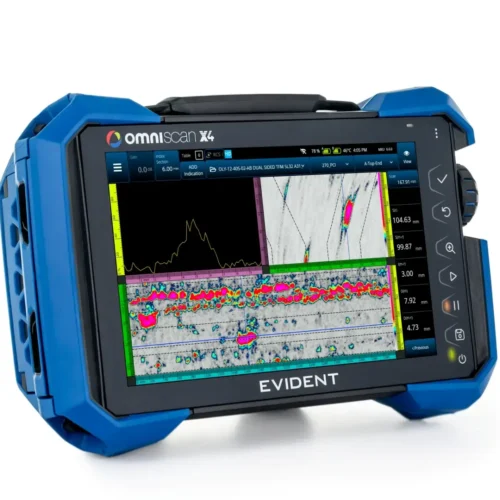
Olympus OmnIScan X3 Phased Array Flaw Detector’s powerful focusing capabilities supported by its larger element-aperture capacity enable you to fully exploit 64-element phased array probes and 128-element aperture TFM. Utilize its enhanced performance to meet the inspection challenges of thick and attenuative materials and expand your potential to develop new procedures for a wider range of applications.
Olympus OmnIScan X3 flaw detector is a complete phased array toolbox. Powerful tools, including total focusing method (TFM) imaging and advanced visualization capabilities, backed by its high image quality enable you to complete your inspection with greater confidence.
Olympus OmnIScan X3 feature
Benefit from 64-Pulser Phased Array
Exploit the full potential of 64-element phased array probes using the OmniScan X3 64 flaw detector to achieve improved resolution at the focal point.
Slide Right: Acquired using a 32-channel OmniScan X3 unit with a 64-element probe (5L64-A32 model), this S-scan is a high-quality image but the resolution reflects the fact that only the middle 32 elements could be used for the focal law.
Slide Left: Using a full 64-element aperture (5L64-A32 probe), the OmniScan X3 64 flaw detector provides better PA resolution at the focal point, enabling you to more easily distinguish indications that are close together or in a cluster.
Access Full 128-Element Aperture TFM
Made possible by new generation electronics, TFM imaging offers better focusing capabilities for smaller indications and an improved signal-to-noise ratio (SNR). With its 128-element aperture capacity, the OmniScan X3 64 model provides enhanced image clarity.
Slide Right: This TFM image was acquired with 64 elements of a 128-element probe (3.5L128-I4 model) using an OmniScan X3 32-channel model.
Slide Left: Here, the OmniScan X3 64 flaw detector enabled us to use the full 128-element aperture of our 3.5 MHz, 128-element I4 probe. Note the improved resolution and reduced background noise.
Improved Phased Array
Up to 3x as fast as the OmniScan MX2 flaw detector (max pulse repetition frequency)
Single TOFD menu for an accelerated calibration workflow
800% high amplitude range reduces the need to rescan
Onboard Dual Linear Array and Dual Matrix Array probe support accelerates setup creation.
Ease Corrosion Monitoring Using Phased Array
Using phased array to inspect corrosion offers many benefits, including excellent coverage and resolution. However, becoming proficient in phased array techniques can be challenging. The OmniScan X3 flaw detector combines advanced functions such as gate synchronization with thoughtfully designed software and simplified menus, so you can obtain accurate data more easily. Configure your setup quickly thanks to its A-scan synchronization processing and manual time-corrected gain (TCG).
Olympus OmnIScan X3 Specifications
| Type | Multigroup, multimode ultrasonic flaw detector | | Size (W × H × D) | 335 mm x 221 mm x 151 mm (13.2 in. x 8.7 in. x 5.9 in.) | | Weight | 5.7 kg (12.6 lb) (with 1 battery) | | Hard Drive Capacity | OmniScan X3 : Internal 64 GB SSD
OmniScan X3 64 : Internal 1TB SSD
extendable using an external USB drive | | Storage Devices | SDHC™ and SDXC™ cards or most standard USB storage devices | | Max Onboard File Size | 25 GB | | GPS | Yes (unless specified otherwise for some regions) | | Alarms | 3 | | Wireless Connection | Yes – wireless LAN dongle included in the package (model varies according to region) | | PA Connectors | 1 connector | | UT Connectors | 4 (2 channels P/R) | | Certifications | ISO 18563-1:2015
ISO-22232-1:2020 | | Display | | Type | TFT LCD with resistive touch screen | | Size | 269 mm (10.6 in.) | | Resolution | 1280 × 768 pixels | | Number of Colors | 16 million | | Viewing Angles | Horizontal: −85° to 85°
Vertical: −85° to 85° | | I/O Ports | | USB 2.0 | 2 ports (one hidden behind the battery) | | USB 3.0 | 1 port | | Video Output | Video out (HDMI) | | Memory Card | SDHC port | | Communication | Ethernet | | I/O Lines | | Encoder | 2-axis encoder line (quadrature quadrature direction), 3rd encoder ready | | Digital Input | 6 digital inputs, TTL | | Digital Output | 5 digital outputs, TTL | | Acquisition On/Off Switch | Through the configuration of a digital input | | Power Output Line | 5 V nominal, 1 A (short-circuit protected), and 12 V output at 1 A | | External DC Supply | | DC-IN Voltage | 15 VDC to 18 VDC (min. 50 W) | | Connector | Circular, 2.5 mm pin diameter, center-positive | | Battery | | Type | Lithium-ion battery | | Capacity | 87 Wh | | Number of Batteries | 2 | | Life | 5 hours using 2 batteries (hot-swap capable) | | PA/UT Configuration | | Bit Depth | 16 bits | | Maximum PRF | 20 kHz | | Frequency | | Effective Digitizing Frequency | Up to 100 MHz | | Display | | Refresh Rate | A-scan: 60 Hz; S-scan: 20 Hz to 30 Hz | | Envelope (echo-dynamic mode) | Yes: Volume-corrected S-scan (30 Hz) | | A-Scan Height | Up to 800% | | Synchronization | | On Internal Clock | 1 Hz to 10 kHz | | External Pace | Yes | | On Encoder | On 2 axes: from 1 to 65,536 steps |
Olympus OmnIScan X3 Specifications Data Specifications| Processing | | Maximum Number of A-Scan Data Points | Up to 16,384 | | Real-Time Averaging | PA: 2, 4, 8, 16
UT: 2, 4, 8, 16, 32, 64 | | Rectification | RF, full wave, half wave , half wave- | | Filtering | PA channel (OmniScan X3): 8 low-pass, 6 band-pass, and 4 high-pass filters
PA channel (OmniScan X3 64): 9 band-pass and 7 high-pass filters
UT channel: 8 low-pass, 6 band-pass, and 4 high- pass filters (3 additional filters when configured in TOFD) | | Video Filtering | Smoothing (adjusted to the probe frequency range) | | Programmable TCG | | Number of Points | 32: One TCG (time-corrected gain) curve per focal law | | Range | PA (standard): 40 dB per step of 0.1 dB
UT: 100 dB per step of 0.1 dB | | Maximum Slope | PA (standard): 40 dB/10 ns
UT: 40 dB/10 ns |
|
Olympus OmnIScan X3 Specifications Acoustic Specifications
| Model | OmniScan X3 | OmniScan X3 64 | Both | | Pulser | PA Channel | PA Channel | UT Channels | | Voltage | 40 V, 80 V, and 115 V | 10 Vpp, 20 Vpp, 40 Vpp, 80 Vpp, 120 Vpp, and 160 Vpp | 85 V, 155 V, and 295 V | | Pulse Width | Adjustable from 30 ns to 500 ns; resolution of 2.5 ns | Adjustable from 30 ns to 1000 ns (half period of bipolar pulse or duration of negative of pulse); resolution of 5 ns | Adjustable from 30 ns to 1,000 ns; resolution of 2.5 ns | | Fall Time | < 10 ns | < 10 ns | < 10 ns | | Pulse Shape | Negative square pulse | Bipolar negative-positive square pulse Negative square pulse | | | Output Impedance | 28 Ω in pulse-echo
24 Ω in pitch-catch | 35 Ω | < 30 Ω | | Receiver | PA Channel | | UT Channels | | Gain Range | 0 dB to 80 dB maximum input signal; 550 mVp-p (full-screen height). | 0 dB to 80 dB; maximum input signal 900 mVp-p (full-screen height). | 0 dB to 120 dB maximum input signal; 34.5 Vp-p (full-screen height). | | Input Impedance | 57 Ω ± 10% at 9 MHz in pulse-echo
100 Ω ± 10% at 9 MHz in pitch-catch | 120 Ω ±10 % at 13 MHz | 50 Ω in pulse-echo mode
50 Ω in pulse-receive mode | | System Bandwith | 0.5 MHz to 18 MHz | 0.2 MHz to 26.5 MHz | 0.25 MHz to 28 MHz | | Beam Formation | PA Channel | | UT Channels | | Scan Type | Single, linear, sectorial, compound, and TFM | – | | Maximum Aperture | OMNIX3-PATFM1664PR = 16 elements
OMNIX3-PATFM16128PR = 16 elements
OMNIX3-PATFM32128PR = 32 elements | OMNIX3-PATFM64128PR = 64 elements | – | | Number of Receiving Elements | OMNIX3-PATFM1664PR = 64 receiving elements
OMNIX3-PATFM16128PR = 128 receiving elements
OMNIX3-PATFM32128PR = 128 receiving elements | OMNIX3-PATFM64128PR =128 elements | – | | Number of Focal Laws | Up to 1024 | – | | Delay Range Transmission | 0 µs to 10 µs in 2.5 ns increments | 0 µs to 10 µs in 5 ns increments | – | | Delay Range Reception | 0 µs to 6.4 µs in 2.5 ns increments | – |
|
TFM/FMC| Supported Modes | Pulse-echo: L-L, T-T, and TT-TT
Self-tandem: LL-L, TT-T, TT-L, TL-T, LT-T, TTT-TT, and TL-L | | Number of Groups | Up to 4 simultaneous TFM groups | | Maximum Aperture | 64-element aperture for 64:128PR
64-element extended aperture (32:128PR only)
32-element extended aperture for 16:64PR and 16:128PR
128-element extended aperture for 64:128PR | | Image Resolution | Up to 1024 × 1024 (1 M points) for each TFM group | | Live TFM Envelope | Yes |
Operating Environment| Ingress Protection Rating | IP65 certified (completely protected against dust and water jets from all directions (6.3 mm nozzle)) | | Shockproof Rating | Drop tested according to MIL-STD-810G | | Intended Use | Indoor and outdoor use | | Altitude | Up to 2,000 m (6,561 ft) | | Operating Temperature | −10 °C to 45 °C (14 °F to 113 °F) | | Storage Temperature | −20 °C to 60 °C (−4 °F to 140 °F) (with battery inside)
−20 °C to 70 °C (−4 °F to 158 °F) (with no battery inside) |
|
Reference









 English
 Spanish
 French
 German
 Dutch