

Description
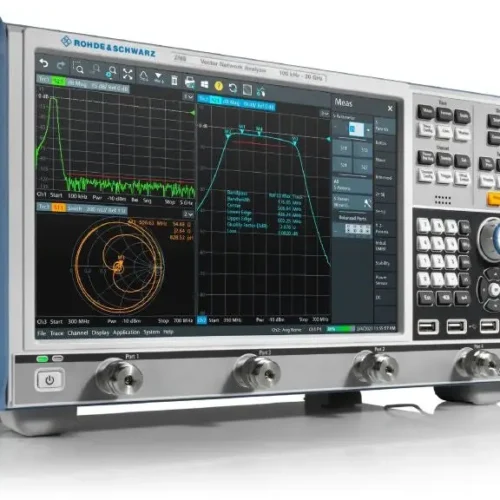
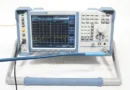
The Rohde & Schwarz FSV40-N Spectrum Analyzer is five times faster than comparable signal and spectrum analyzers and provides measurement routines that are optimized for speed and high data throughput. This is a crucial advantage in production applications.
The Rohde & Schwarz FSV40-N is the fastest and most versatile signal and spectrum analyzer available for performance oriented, cost-conscious users working in the development, production, installation and servicing of RF systems.
In development applications, the Rohde & Schwarz FSV excels due to its outstanding RF properties, a 40 MHz signal analysis bandwidth that is unmatched in its class, and a wide range of analysis packages for analog modulation methods as well as wireless and wideband communications standards.
The Rohde & Schwarz FSV is five times faster than comparable signal and spectrum analyzers and provides measurement routines that are optimized for speed and high data throughput. This is a crucial advantage in production applications.
Rohde & Schwarz FSV40-N Configured
The R&S FSV-K54 EMI measurement application adds EMI diagnostic functionality to the R&S®FSV and R&S FSVA signal and spectrum analyzers. R&S®FSV-K54 offers EMI bandwidths for commercial and military applications, as well as CISPR detectors, limit lines and correction factors. All electronic devices must be tested for electromagnetic compatibility (EMC) prior to market approval. The ability to assess and influence the EMC behavior of products during the design phase is one of the critical factors in developing successful products. Preventing expensive product redevelopment and performing smooth certification help to ensure a timely market launch. FSV40-N Spectrum Analyzer allows users to analyze the effectiveness of shielding measures and the effects of changes to the circuit or design prior to testing in the EMC lab.
EMI detectors in line with CISPR16-1-1
- Flexible allocation of EMI detectors such as quasi-peak, CISPR-average and RMS-average as well as allocation of peak and average detectors to different traces
- Fast, easy-to-read diagnostic measurements with high result reproducibility
- Easy detection of critical disturbance signal amplitudes
Marker demodulation
- Fast and reliable identification of AM and FM signals
- Measurement bandwidths in line with CISPR and MIL-STD
- Diagnostic measurements during development deliver the correct amplitude of the disturbance signal thanks to the 6 dB bandwidths (CISPR from 200 Hz to 1 MHz, MIL-STD from 10 Hz to 1 MHz)
Measurement markers for evaluating EMI
- Markers can be placed on the frequencies of disturbance signals to make targeted analysis easier
- The ability to link markers to up to six traces and to associated EMI detectors provides users with a direct reference to EMI limits
- Automatic searching for disturbance maxima for reliable detection of time-varying interferers
- Critical frequencies are entered in a peak list for fast evaluation of a frequency spectrum with respect to official EMI emission limits
Rohde & Schwarz FSV40-N Features
- 10 Hz to 40 GHz
- Up to 160 MHz signal analysis bandwidth
- Convenient, intuitive operation with touchscreen based user interface 5 GHz
- 0.4 dB level measurement uncertainty up to 7 GHz
- –110 dBc (1 Hz) phase noise at 10 kHz frequency offset
- +15 dBm third-order intercept (TOI)
- Displayed average noise level (DANL) in 1 Hz bandwidth: –155 dBm at 1 GHz, –147 dBm at 30 GHz; with R&S®FSV-B24 preamplifier: –162 dBm at 30 GHz
- General-purpose measurement applications for phase noise, noise figure, vector signal analysis, analog demodulation, EMI diagnostics
Rohde & Schwarz FSV40-N Specification
| Form Factor | |
| Plug-In ( /B1 ) | |
| Application Software | |
| CDMA2000 ( /K82 ) | |
| GSM with Edge ( /K10 ) | |
| HSDPA ( /K72 ) | |
| HSUPA ( /K73 ) | |
| MIMO (802.11n) ( /K102 /K91n ) | |
| Noise Figure ( /K30 ) | |
| Phase Noise ( /K40 ) | |
| TD-SCDMA ( /K76 ) | |
| Average Noise Level | |
| +15 dBm | |
| Frequency | |
| 20 Hz ( /B29 ) | |
| 1.6 MHz – 2 MHz ( /HX002F ) | |
| 5 Hz – 10 MHz ( /HZ-10 ) | |
| 9 KHz – 20 MHz ( /HE300HF ) | |
| 100 Hz – 30 MHz ( /HE525 /HM525 ) | |
| 9 KHz – 30 MHz ( /HM020 /Z6 ) | |
| 1.5 MHz – 30 MHz ( /HA104 /HV3011 /HX002A1 /HX002M1 ) | |
| 2 MHz – 30 MHz ( /HL451 /HX002 ) | |
| 3 MHz – 30 MHz ( /HL471 ) | |
| 40 MHz ( /B70 ) | |
| 9 KHz – 80 MHz ( /HE010 ) | |
| 10 KHz – 80 MHz ( /HE016 ) | |
| 20 MHz – 87 MHz ( /HE402 ) | |
| 108 MHz – 118 MHz ( /HF108 ) | |
| 100 MHz – 156 MHz ( /HS9043/9 ) | |
| 100 MHz – 165 MHz ( /HK012 ) | |
| 30 MHz – 200 MHz ( /HE526 ) | |
| 20 MHz – 300 MHz ( /HK116 ) | |
| 30 MHz – 300 MHz ( /HZ-12 ) | |
| 225 MHz – 400 MHz ( /HK001 ) | |
| 20 MHz – 500 MHz ( /HE302 /HE314A1 ) | |
| 27.5 MHz – 600 MHz ( /HK055L1 /HK055L1 ) | |
| 9 KHz – 1 GHz ( /HZ-14 ) | |
| 200 MHz – 1000 MHz ( /HE202 /HE527 ) | |
| 300 MHz – 1000 MHz ( /HZ-13 ) | |
| 20 MHz – 1300 MHz ( /HE309 /HK309 ) | |
| 80 MHz – 1300 MHz ( /HL007A2 /HL046 ) | |
| 100 MHz – 1300 MHz ( /HK014 ) | |
| 200 MHz – 1300 MHz ( /HL223 ) | |
| 500 MHz – 1300 MHz ( /HF214 ) | |
| 2 GHz ( /NAZ10 ) | |
| 100 KHz – 2 GHz ( /HZ-11 /HZ-11 ) | |
| 80 MHz – 2000 MHz ( /HL033 ) | |
| 9 KHz – 3 GHz ( /B1 ) | |
| 20 MHz – 3000 MHz ( /HE500 ) | |
| 80 MHz – 3000 MHz ( /HL046E ) | |
| 1 GHz – 3 GHz ( /HF902 ) | |
| 400 MHz – 3600 MHz ( /HL040 ) | |
| 4 GHz ( /NAZ30 ) | |
| 9 KHz – 7 GHz ( /B22 ) | |
| 100 KHz – 7 GHz ( /B9 ) | |
| 800 MHz – 18 GHz ( /HF907 ) | |
| 1 GHz – 18 GHz ( /HL024A1 /HL024S2 /HL024S7 /HL024S8 /HL024S9 ) | |
| 7.5 GHz – 18 GHz ( /HF907DC ) | |
| 800 MHz – 26.5 GHz ( /HF907OM ) | |
| 850 MHz – 26.5 GHz ( /HL050 ) | |
| 40 GHz | |