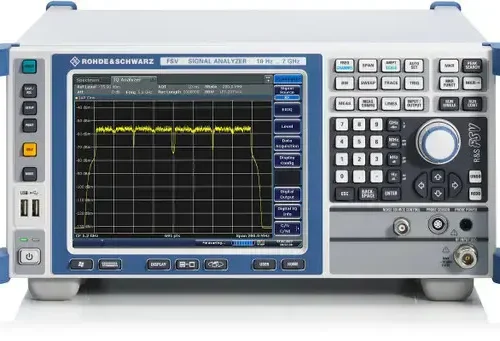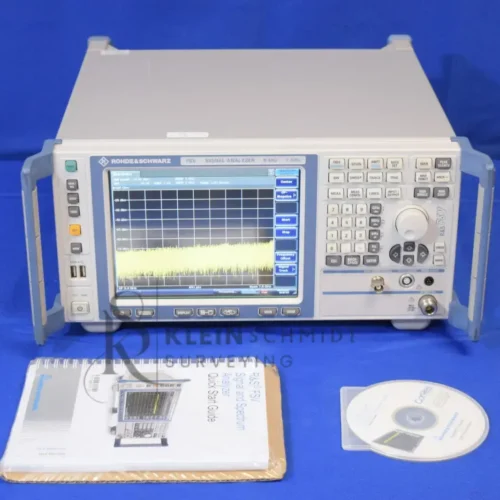

Among the best handheld Raman spectrometers are the Bruker BRAVO and Thermo TruScan RM. These devices are great options for pharmaceutical and manufacturing compliance. The Gemini model combines Raman and IR for more complex analysis. NanoRam-1064 excels with fluorescent samples, and FirstDefender RMX gives hazmat and defense teams reliable chemical identification in tough conditions.
You face real pressure when your readings determine safety and operational success. A wrong reading can delay production, cause regulatory issues, or put teams at risk. Choosing the right instrument solves that problem by providing instant on-site results.
Industries trust the Bruker BRAVO, Thermo TruScan RM, Gemini, NanoRam-1064, and FirstDefender RMX for consistent performance. Whether you work in pharmaceuticals, manufacturing, or security, you can find a model that fits your workflow.
What Is the Use of a Handheld Raman Spectrometer?
A handheld Raman spectrometer helps you identify materials without cutting, burning, or preparing samples. You point the device at a surface, and the laser reveals the molecular makeup. It’s used to verify raw materials, detect contaminants, and confirm chemical identity on the spot.
In laboratories and production areas, Raman spectroscopy equipment saves time by allowing direct analysis through containers or packaging. You can:
- Check incoming goods
- Test powders or liquids
- Confirm product quality in real time
Forensic and customs officers also use it in the field to identify unknown substances fast and make informed safety decisions.

Which Is Better, Raman or FTIR?
Both Raman and Fourier Transform Infrared (FTIR) spectroscopy measure how molecules respond to light, but in different ways. FTIR detects how a sample absorbs infrared light, while a portable Raman analyzer captures how it scatters laser light. You use Raman when working with water-based, colored, or opaque materials since it reads through glass or plastic with ease.
FTIR is suitable for dry powders, films, and materials that reflect infrared light cleanly. Raman shines in field testing because it requires little preparation and gives clear chemical fingerprints. The better choice depends on what you’re testing and where you plan to use the instrument.

What Can Raman Spectroscopy Not Detect?
A field Raman spectrometer is powerful, but it still has limits. It struggles with substances that don’t scatter light well or have strong fluorescence, which can hide the signal. Metals, for example, have free electrons that prevent bond polarization, so they produce little or no Raman signal.
You also face challenges with dark or highly fluorescent samples, as their glow obscures the Raman signal. In those cases, another testing method may give better results.
Common materials that Raman has trouble analyzing include:
- Pure metals and alloys
- Noble gases
- Simple ionic compounds
Why Use Raman Instead of IR?
You use Raman when you need quick, non-contact testing with clear chemical identification. Infrared spectroscopy measures light absorption, while Raman measures light scattering. This difference makes Raman better for aqueous solutions and materials sealed in glass or plastic.
Raman also works on samples that require no surface prep or contact. Compared with IR systems, portable spectroscopy tools such as handheld Raman units can handle a wider range of environments and sample types. You can test through packaging, on the production floor, or in the field with minimal setup.
Raman offers practical benefits such as:
- Accurate results without sample prep
- Effective reading through transparent containers
- Reliable data from wet or mixed materials
- Fast confirmation of chemical identity in real time
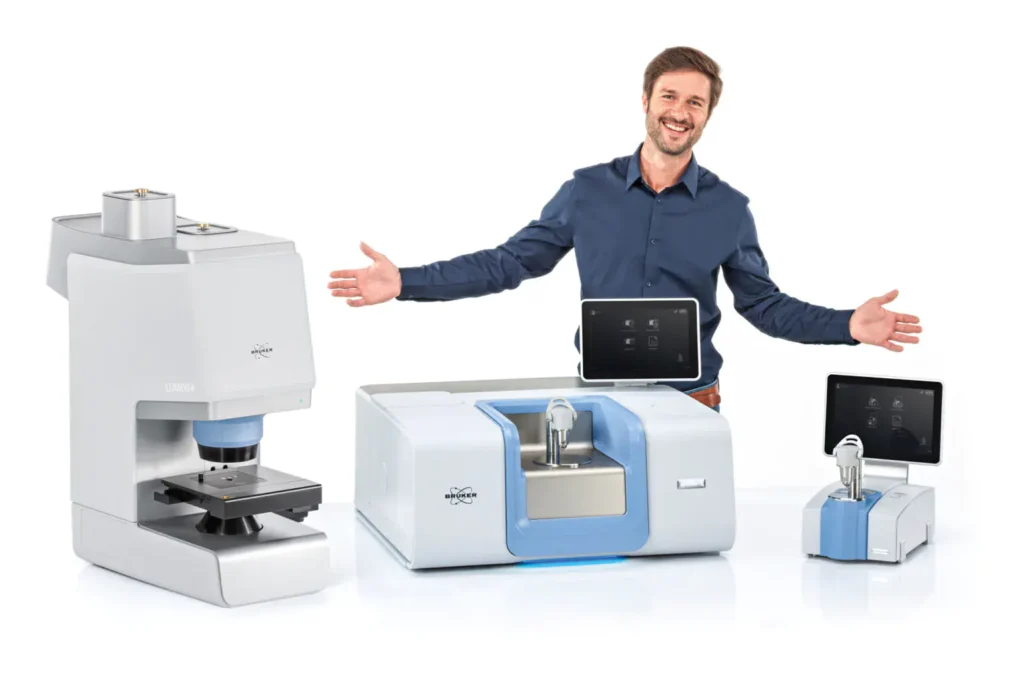
Comparison of the Leading Handheld Raman Spectrometers in 2026
Choosing the right handheld Raman spectrometer can shape how efficiently you identify and verify materials in your work. Here’s how the top models compare:
1. Bruker BRAVO
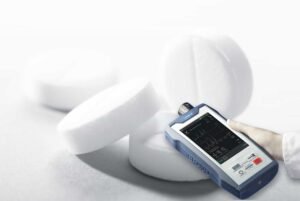
The Bruker Bravo is made for professionals who need reliable material verification in both lab and field conditions. It uses DuoLaser technology to reduce fluorescence and capture clear spectra from:
- Tablets
- Powders
- Liquids
You can scan samples directly through glass or plastic without breaking seals or risking contamination.
For pharmaceutical and chemical facilities, it meets 21 CFR Part 11 and GMP standards. Secure logins, audit trails, and electronic signatures protect every record, giving you traceable proof during audits or inspections.
Key Raman spectrometer features of the device include:
- Automated calibration and system self-checks for consistent accuracy
- Intuitive touchscreen interface for simple, guided operation
- Reference library of over 20,000 substances
- Battery-powered portability for in-plant or warehouse testing
You can use BRAVO at the loading dock to check raw materials. You can also use it in cleanrooms for batch release. Additionally, you can take it into the field for on-site chemical checks.
2. Thermo TruScan RM
Among the best Raman models 2026, the Thermo TruScan RM stands out for dependable raw material identification in both production and field environments. It uses a rugged optical design that analyzes solids and semi-solids without sample prep.
The sealed housing and simple interface make it practical for warehouse or outdoor testing where conditions change fast. To maintain data integrity and meet regulatory expectations, the device supports the following standards:
- 21 CFR Part 11
- USP <1120>
- GMP
Each scan is saved with user details and time stamps. This creates a record that meets quality and audit requirements. Its structure integrates smoothly into pharmaceutical and manufacturing workflows.
You’ll find the TruScan RM valuable for:
- Verifying raw materials at receiving docks
- Checking active ingredients before blending
- Screening chemicals in storage or transit
- Field testing by customs or security officers for quick identification
As a handheld Raman spectrometer, it provides dependable results and full compliance in both lab and field operations. Its sealed, impact-resistant casing protects sensitive optics from dust and temperature shifts. It therefore allows you to maintain accuracy even in demanding environments.
3. Thermo Gemini
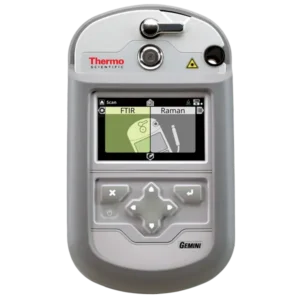
The Thermo Gemini combines Raman and infrared spectroscopy into a single portable device. This gives you more material options in both field and lab settings. It automatically selects the best method for each sample.
The Gemini ensures fast and accurate identification even when fluorescence or opacity limits one approach. This hybrid setup helps you classify unknowns with greater certainty.
Key benefits of the Gemini for buyers exploring a Raman analyzer for sale include:
- Rapid identification of explosives, narcotics, and toxic chemicals
- Dual Raman-IR capability for complex or opaque samples
- Rugged design that withstands field impact and weather changes
- Automatic data logs for accurate chain-of-custody tracking
The instrument is designed for several groups. They include:
- First responders
- Forensic labs
- Border inspection teams
It meets global safety and data-integrity expectations, with secure record storage and automated reporting for traceability. Its documentation features support defensible, court-ready results and reliable evidence handling.
The Gemini is strong and has dual-detection power. This makes it a reliable tool for professionals. They need dependable identification for real-world investigations and security operations.
4. NanoRam-1064

When fluorescent interference prevents clear readings, the NanoRam 1064 offers a practical solution. Its 1064 nm laser penetrates challenging samples that standard 785 nm systems can’t handle, producing cleaner spectra from:
- Dyes
- Natural products
- Colored pharmaceuticals
The unit’s compact form lets you move easily between:
- Lab benches
- Production lines
- Inspection sites
The NanoRam-1064 meets 21 CFR Part 11 and GMP requirements for regulated industries. It ensures secure data handling and keeps audit-ready records.
Every scan is automatically time-stamped and linked to the operator. It allows you to trace material verification from intake to final product release. These compliance tools help maintain data integrity across different testing points.
Unlike most compact instruments, this handheld Raman spectrometer delivers stable results under variable lighting and temperature. It’s built for routine use in both cleanrooms and field operations. You get consistent chemical confirmation even when fluorescent materials limit the performance of traditional Raman systems.
5. FirstDefender RMX
The FirstDefender RMX is built for fast chemical threat identification in unpredictable environments. It’s a reliable standard for comparing field spectrometers. It provides fast, accurate readings of hazardous solids and liquids without opening containers.
The system can be integrated with select tactical robots to perform analyses in hard-to-reach or hazardous areas. This setup gives you more flexibility during on-site inspections or emergency responses.
Unlike many laboratory Raman devices, the RMX is designed for direct use by first responders and security teams. It maintains accuracy even in rough field conditions, allowing it to withstand:
- Drops
- Dust
- Water exposure
Its rugged build meets MIL-STD-810 requirements, proving its reliability under:
- Heat
- Cold
- Vibration
The RMX records every scan with a time stamp, providing a traceable electronic record for investigations and compliance reviews. The system’s secure, time-stamped data records help support the chain of custody. This process goes from field sampling to lab verification.
The RMX delivers dependable performance in the field for:
- Hazmat teams handling unknown chemicals
- Customs officers screening imports and cargo
- Defense personnel working in tactical or high-risk areas
Quick, traceable chemical identification helps teams make safer decisions and respond faster.
Frequently Asked Questions
What Is the Basic Principle of Raman Spectroscopy?
The basic principle of Raman spectroscopy is light scattering. When a laser hits a sample, most of the light scatters at the same energy. However, a small part of the change is due to how the molecules vibrate. This energy shift creates a unique pattern that identifies the material’s molecular structure.
You measure these energy shifts to learn what the sample is made of. The technique helps you confirm chemical composition, detect impurities, and study molecular bonds without damaging or altering the sample.
What Is the Best Wavelength for Raman Spectroscopy?
The best wavelength for Raman spectroscopy depends on the type of sample you’re testing. Most lab systems use 532 nm or 785 nm lasers for clear, high-resolution spectra. The 1064 nm laser is better when samples give off strong fluorescence. You choose the wavelength based on how much light your material scatters and how much background signal it creates. Using the right laser ensures sharper results and reduces measurement interference.
Can Raman Detect Water?
Raman spectroscopy can detect water, but it produces a weak signal because water molecules scatter light poorly. The technique identifies the O-H vibrational bands, which confirm the presence of water in a sample. You can still measure moisture content or hydration levels. However, the low Raman intensity indicates that the results improve when water mixes with other substances, not when it serves as the main one.
What Is the Main Challenge of Raman Spectroscopy?
The main challenge in Raman spectroscopy is fluorescence, which can mask the true Raman signal and make spectra difficult to read. Fluorescent light often appears when testing colored or complex samples, drowning out valuable data.
You can reduce the effect by using longer wavelengths, such as 1064 nm. Alternatively, select instruments designed to handle fluorescent materials, providing clearer, more reliable results.
What Is the Raman Limit?
The Raman limit is the minimum concentration or sample size at which the signal becomes too weak to detect. It marks the point at which light scattering no longer yields sufficient measurable data for clear identification.
You reach this limit more quickly with materials that scatter light poorly or exhibit strong fluorescence. Using higher laser power or better optics can lower that limit. This helps you detect smaller amounts more accurately.
How Can You Reduce Noise in Raman?
You can reduce noise in Raman spectroscopy by improving signal strength and minimizing background light. Using higher laser power, longer exposure, or a cleaner optical path helps produce clearer spectra.
Filtering unwanted light and keeping samples still during measurement also lowers interference. You get better results when the instrument is set up correctly. The optics should be clean, and the laser wavelength must match the material you are testing.
How Do You Increase Raman Intensity?
You can increase Raman intensity by increasing the laser power and improving the interaction between the light and your sample. A clean surface and proper focus help more photons scatter, leading to stronger spectral peaks.
Choosing the right wavelength also boosts signal strength. Shorter wavelengths, such as 532 nm, often produce higher intensities. Proper alignment and stable sample positioning help maintain a steady signal during testing.
Make the Most of Your Handheld Raman Spectrometer. A handheld Raman spectrometer helps you quickly and accurately identify materials anywhere you go. Some of the top ones include the Bruker BRAVO, Thermo TruScan RM, Gemini, NanoRam 1064, and FirstDefender RMX. Each solves different challenges while keeping results clear and traceable.
At Kleinschmidt Surveying, we have many years of experience. We help engineers, surveyors, and field professionals get accurate measurements and dependable results. All our instruments come from trusted brands known to industry experts. Check out our website to get the right equipment for precise, reliable results in every project.